LoRAception
Predicting and composing LoRAs for content-preserving style transfer, without optimization per reference.
Meters show the mean over all 120 benchmark pairs at the selected λ (β = 0.5, neutral prompt “An image.”). λ = 3 is the setting used in the paper.
One hypernetwork predicts both LoRAs
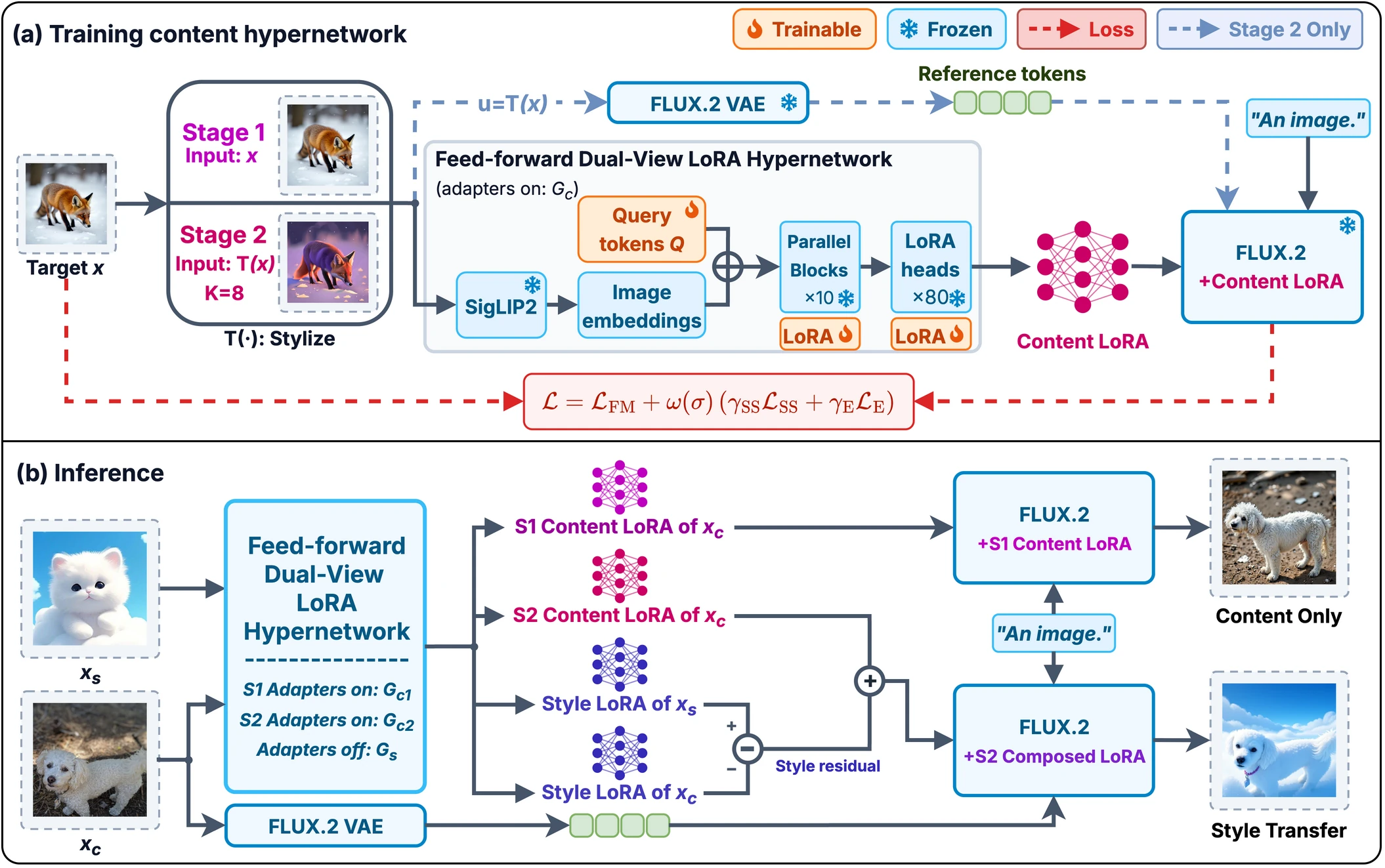
A pretrained image-to-LoRA hypernetwork predicts style LoRAs for FLUX.2. Switchable adapters let the same network also predict an image-specific content LoRA. The two predictions are composed in weight space into a single LoRA, and the content image enters FLUX.2 as reference tokens.
Every pair, every method
Pick any of the 12 DreamBooth subjects and 10 style references used in the paper. Each tile is the unselected output of that method for this pair. Open a tile to compare it with ours using a wipe slider.
Renders are center-cropped and downsized to 384 px for this page. All FLUX.2-based rows share the initial noise for each content. Baselines use their released code and each paper’s own protocol; ZipLoRA and K-LoRA train their content LoRA on the 4–6 DreamBooth photos of the subject, as in their papers. CRAFT-LoRA runs without its rank-constrained stage, which is not publicly available.
What each component contributes
The same pair rendered with one component changed at a time. Numbers are means over all 120 pairs (β = 0.5, λ = 3, neutral prompt). Change the pair in the comparison section above or in the demo at the top.
What a predicted content LoRA knows
Each tile shows a source photo. Hover or tap it to see what FLUX.2 generates from the Stage-1 content LoRA of that photo alone, with the prompt “An image.” and no reference tokens. The prompt says nothing about the subject, so subject and layout come from the predicted weights.
In a same-class LoRA-swap test with a fixed caption, a blind VLM evaluator recovered 83% of the target’s layout cues with the correct content LoRA and 32% with another image’s LoRA. Appearance details such as colour are not always kept, which motivates the reference-conditioned Stage 2.
Content–style trade-off
Content similarity (DINOv2) against style similarity (CSD) for every method. The magenta curve is our λ sweep at β = 0.5; the ringed point is λ = 3. No method leads on every metric. Click a point to open that method in the comparison viewer.
DINO, CLIP-I and Depth: content preservation. CSD and FID: style alignment. LAION: aesthetic score. VLM: overall score (0–5) of a method-blind Qwen3-VL-32B judge. Underlined: best in column. Click a header to sort. Methods differ in backbone, conditioning, resolution and reference data.